Undergraduate Journalism Content
While much of my focus is on my ceramic practice, I am also pursuing journalistic writing and content outside of ceramics. I find telling stories fascinating and would like to find a way to merge the two mediums into one. The writing samples are the top stories I have written in my undergraduate career and the podcast episodes (tbd) were created at the end of my senior year. I am fascinated by audio and would like to find a way to talk to artists in audio form to share their stories.
5 Things We Have Notes Taught Me About Pop Culture, Community, and (yes) Ellipses
09/25/2025
Olivia Trevino
Reading We Have Notes is like sitting next to your cool aunt at a concert–you know, the one who is ready to discuss Haylor and unpack the impact of late stage capitalism. It’s pop culture, but with layers, like an onion. It’s funny, a little messy, super online–and truly on to something. After binging a few posts, here’s what stood out to me:
Pop Culture is Never Simply Just Pop Culture
A Taylor Swift Lyric, a TV finale, or a viral TikTok sound isn’t treated as something trivial Instead, the posts zoom out to show how these moments connect to something larger: a representation of generational values, cultural anxieties, and even the political climate. The blending of little moments to large complex systems feels intentional, breaking down the idea that entertainment and pop culture is “less than” intellectual thought.
Being Vulnerable (Even When It's Uncomfortable) Builds Community
The posts don’t shy away from messy and complicated emotions, rather they lean into those complicated feelings. Whether it’s nostalgia, burnout, or the complicated pleasure of being “chronically online”, there is space for all the emotions. By the author admitting imperfection, she creates a space where readers feel invited to connect, rather than feeling shame or embarrassment for their likes and dislikes. She’s saying to us, “I’m figuring this out too–join me in figuring it out.” That openness with her audience is a big part of the brand.
The Punctuation Is The Personality
Ellipses, em-dashes, and parentheses aren’t just stylistic quirks–they are the author’s stage directions for how we are supposed to hear the text. The way she writes feels like how people talk: fast, tangential, and full of side commentary. Reading it feels less like an article and more like a voice memo from a friend.
Nostalgia as a Shared Language
Stevie Nicks, early internet, old school TV, and other Gen Z cultural moments, it's definitely all there. But instead of a gatekeep-y “back in my day” vibes, it's giving more like, “This is my cultural baggage, show me yours?” Nostalgia becomes an icebreaker between generations.
Being Chronically Online Is a Flex
Yes, she owns being “chronically online”–but instead of cringing about it, she turns it into a superpower. It’s awesome to see someone embrace their weirdness and flaunt it. Knowing the memes, the trends, the moments, and the discourse cycles gives her fuel to decide where the culture is going. It's not just screen time; it’s research.
TL:DR
We Have Notes isn’t just pop culture commentary–it’s community, conversation, and connection. It's about finding meaning (and laughs) in the stuff we’re already obsessed with. Pop culture isn’t background noise–it’s the whole conversation.
Total Addiction: Chasing the Shadow of the Moon
04/03/2024
By Olivia Trevino
BLOOMINGTON, Ind – Cathy Gretencord has been travelling across the world since 1999 searching for a rare celestial event: solar eclipses. She has travelled to 10 countries, trying to satisfy her itch to be in the umbral shadow.
Humans have been following solar eclipses as early as they were able to chart and predict the patterns of the sun and moon. Eclipse chasers or umbraphiles, like Gretencord, are a niche group of people around the world who connect over their cosmic fascination with solar eclipses.
Gretencord is an Indianapolis native and has been watching the weather to decide on where to watch the eclipse.
For her, eclipses are hard to describe. “It’s as if hundreds of emotions converge – humility, elation, wonder, splendor, peace, fear, awe, and euphoria to name a few.” No eclipse has been her favorite, every single moment is.
This eclipse for Gretencord is a big one: it will allow her to pass 30 minutes spent in totality.
She has seen 10 eclipses in her lifetime. She has been to Austria (1999), Zimbabwe (2001), Libya (2006), Russia (2008), China (2009), Australia (2012), Indonesia (2016), United States (2017), Argentina (2019), and Australia (2023).
Although eclipse chasing is niche, it’s not new.
According to NASA, observations of solar eclipses have been noted as far back as 2500 BC, shown in records from ancient Babylon and China.
Anthony Aveni, astronomer and scholar, writes that as early as 8 BC, Chinese astrologers were able to make accurate predictions of solar eclipses. By the 9th century AD, there were professional eclipse watchers who were tasked with recording eclipses in Baghdad and Cairo.
Although ancient societies like the Greeks, the Chinese, the Babylonians, and the Maya had developed the ability to predict solar eclipses, it wasn’t until Sir Edmond Halley’s findings in 1715 that allowed people to predict exactly where eclipses would happen and for how long, using Isaac Newton’s law of gravity.
According to the American Astronomical society, by the 19th century, chasing eclipses was considered “nothing new for astronomers.” While eclipse chasing was traditionally left up to scholars and astronomers, it has now evolved to a normal person hobby. No special equipment or knowledge is needed to chase eclipses now.
A solar eclipse is when the bright part of the sun is blocked by the moon and the sun looks like a completely black disk in the sky surrounded by the bright pearly white of the Sun’s corona.
“The corona is shaped by the Sun’s magnetic field into gorgeous plumes and streamers extended well away from the sun” said Richard Durisen, professor emeritus in the Indiana University astronomy department.
Jennifer True is a novice eclipse chaser. She saw her first eclipse in 2017 in Franklin, Kentucky, travelling mainly for her 12-year-old daughter who aspires to be an astronaut.
“The first experience really was so moving for us that we instantly wanted to know where we can experience this again in the United States,” said True.
True and her family travelled from Detroit to Muncie, Indiana to experience the April 8 eclipse. The eclipse, once again, was awe-inspiring.
“It was a lovely experience, and we are looking to see where we will need to go in Europe for the next solar eclipse and brush up on our Spanish.” The next solar eclipse will be August 12, 2026 that will pass over Russia, Greenland, western Iceland, and northern Spain.
Eclipse chasers take meticulous notes of the eclipses they have seen and how long they lived in totality.
Richard Durisen has seen four total social eclipses in his lifetime. South Carolina (1970), Hawaii (1991), Munich (1999), and Eastern Oregon (2017).
“The only one where I did not see totality was Munich 1999 when a small cloud moved in front of the Sun only during totality. It was so disappointing” said Durisen.
The overall experience of witnessing a total eclipse is hard to describe. Some describe it as a religious experience, an overwhelming wave of emotions, and mind-boggling. Each eclipse is a unique experience each time, although the same event is happening.
“I would have to say the first was most impactful. It was profoundly beautiful to see such a startling aspect of the world that is ordinarily not visible to our naked eyes. There was a definite ‘oh my god’ quality to it,” Durisen says.
Juli Feller saw her first eclipse in 2017 at the age of 50. She is a high school photography teacher and was chaperoning a trip to Kentucky to see the eclipse. For her, she wasn’t expecting much, she thought it would be like partial eclipses, she has photographed many in her lifetime. But that eclipse changed her life.
After this experience, she became addicted. She began researching eclipses and where to travel but was never able to go chase one. She has waited 7 years to see her second total eclipse.
“For me, the experience is so incredibly spiritual, it touches the very core of my soul. The closest thing I could say to what this experience is like is to say a total solar eclipse is the closest thing to experiencing and feeling God on this earth,” said Feller.
She wants to travel to see the next solar eclipse if she is still able… she will be 77 years old.
A key marker for eclipse chasers is the travelling that is involved if you are truly serious about eclipses. Many eclipse chasers make their travels into full vacations instead of just traveling for the celestial event. It is a unique way to see the world.
Cathy Gretencord turns her eclipse trips into 3-week events for her and her family. When she saw the eclipse in Bali in 2016, it began as four days in Bali, then the eclipse on the tiny island of Ternate, then they visited a coral island in the Celebes Sea, then travelled on to Yogyakarta and Jakarta.
She typically travels solo but occasionally she will travel with an organized group. When she travelled to Libya, she was required to travel with a group.
Her most recent trip was a fifteen-day tour of Australia. She began in Perth then travelled to Exmouth and back. This trip costed her around 300 dollars per day; for :58 seconds in totality.
Richard Durisen also uses it as an excuse to travel with his family. He does it for personal reasons and uses it as an excuse to visit his friends around the country or to visit nice places.
Witnessing a solar eclipse is a once in a lifetime opportunity for most people, but for few it isn’ tenough. Chasers want to take every opportunity to see an eclipse, as there are so few to witness in one’s lifetime. The personal impact that a solar eclipse has on eclipse chaser’s souls is what is addictive. It allows the chaser to feel human and connected to the earth and the world beyond.
A total solar eclipse is impossible to recreate. The size ratio of the moon covering the sun from the earth is perfect and it is not possible to mimic the lovely corona of the sun as it is only visible during totality. There is no other planet/moon ratio that earthlings have been able to study that has a perfect eclipse of their star.
“It is an opportunity to experience perfection,” said Gretencord.
Laurie Hackward witnessed her first solar eclipse on April 8. She had no idea what to expect because she was unable to witness the partial solar eclipse that passed over Indianapolis in 2017.
“It was amazing, I’ve never seen anything like it. I don’t even have the words to describe it.”
Although the eclipse was moving for her, she says that she wouldn’t travel to see a solar eclipse. She doesn’t understand the appeal that drives people to chase them.
“Absolutely not. I mean, it was fantastic but that seems like a lot a work for a couple minutes.”
Graduate Student Led Collaboration Opens at the Tangent Gallery
02/13/2024
By Olivia Trevino
BLOOMINGTON, Ind – The IU Tangent Gallery opened an exhibition called “Objects That Serve” showing a variety of tableware from the Ceramic and Metals departments.
Objects That Serve had its opening reception on Friday February 9th at 6pm and will remain open through March. The gallery was filled with a variety of platters, bowls and cups with flatware created by the departments. The room was filled with people, mainly grad students and faculty from the Eskenazi school.
Ben Akaiwa-Cooke, a second-year graduate student in the Metals department, was the curator for this show. He chose to put it on as a group exhibition to highlight all the artists who wanted to participate.
The Tangent Gallery released an open call for exhibitions to all nine disciplines within the Eskenazi school for the spring semester and Akaiwa-Cooke jumped at the chance. He was a part of the committee that selects submissions and was against his own proposal until a committee member suggested it to be a collaborative show between ceramics and metals.
“We’re both craft media and there’s a lot of very easy connections that can be made through functional ware that is still aesthetically beautiful,” said Akaiwa-Cooke.
It snowballed from there. Graduate students collaborated to match pieces and put it into a cohesive show. The goal was to make it feel how many people live among art.
“People were coming up with pairings and deciding what objects worked well with others, very unlike a normal exhibition, but I feel it’s very accurate to how people want to live with art,” said Akaiwa-Cooke.
Shows like this allow students to experience what it is like to apply and be selected for shows and have their works on display. It also allows students to curate and put on their own individual or group shows.
Meghan Stanley, a first year BFA in the Ceramics department, said that this was her first show that she has been selected for. She remembers watching the fine art students put together these shows last semester and she realized she wanted to pursue this as a career.
“It’s so exciting to be seen as an actual artist,” said Stanley. “I wouldn’t want my work to be shown with anybody else”.
The IU African American Dance Company performance at the Monroe County Public Library for MLK Day
01/15/2024
By Olivia Trevino
BLOOMINGTON, Ind – The IU African American Dance Company performed their third consecutive performance of “We Live to Dance” at the Monroe County Public Library for Martin Luther King Jr. Day.
In the auditorium of the public library, children and families gathered to watch the performance by the IU African American Dance company. The two performances, at 2pm and 3pm, shared traditions from Nigeria and Ghana through dance and music, wearing traditional West African outfits and singing in traditional languages.
Baba C. Stafford Berry Jr, the director of the dance company and IU professor of Theatre, Drama, and Contemporary Dance and African American and African Diaspora studies described the performance as a way to “extend from Africa and all the way across the diaspora, to where we are now.”
The performances were very interactive, the director created many calls and responses for the audience to interact with, along with simple dance moves to do in the audience.
The first performance entitled “becoming comfortable in the unknown”, performed by two IU students, was an intimate performance about pushing yourself to try new experiences.
The second performance was interactive, the dancers brought the children from the audience on stage to dance the “Kpanlogo” with them. This dance was a traditional dance from Ghana, to celebrate the harvest. This dance changed into a popular social dance after Ghana gained independence in the 1950’s.
Jaylen Ray, the associated instructor of the company, helped plan the event and choreograph the dances. He graduated from IU in 2020 with a BFA in dance. He has been with the company for 7-8 years and said “every semester of my undergrad and I knew I needed a job there”.
The IU African American Dance company is one part of three African American performing groups in Bloomington, including the African American Choral Ensemble and IU Soul Revue. They gather once a year for the annual Potpourri of the Arts Concert at IU Auditorium.
Speaking to the Co-president of the dance company, Assata Dailey, she said she first became introduced to this community through one of Professor Stafford’s classes. She joined the class thinking it was a history class but soon learned that it was a dance class.
At the Potpourri of the Arts performance, Assata fell in love with the company. She said, “when I saw them perform I knew I needed to join”.
She pointed out many differences about the company that makes it unique from other black spaces on campus, talking about inclusivity and diversity.
“We find our own way to navigate our space without excluding anybody”.
Indiana University Is Taking Over Bloomington, Indiana
04/13/2023
By Olivia Trevino and Emma Ramirez
BLOOMINGTON, Ind – Bear’s Place, after struggling to recover from the pandemic, decided to close their doors on February 11, 2022. This was a big loss for townies and IU students alike; this bar was legendary. But this was only the beginning; the closing of Bear’s Place started a domino effect of small businesses closing on Third Street and the greater Bloomington area.
Businesses have closed down on Third Street over the last few years seemingly due to the changing of ownership of the property the businesses sit on. The new owner?
Indiana University.
Bloomington Bagel Company (BBC), the first on-site scratch bagel bakery opened its doors in 1996 and over time increased their business to 4 separate locations throughout the Bloomington area. They closed their doors of their 3rd Street location abruptly at the end of February this year.
Speculation of the reason for the closing could be heard throughout Bloomington. Reddit boards shared conspiracy theories hypothesizing why BBC moved out, and local business owners had their ideas, but no one had the answer. We reached out to the owner, Sue, asking for a comment to help explain the closing. We were told “No comment” and had to move on.
After doing research, we found that Bear’s Place (Bloomington Bagel operates out of an extension of Bear’s Place) was bought by Indiana University for ~3.2 million dollars. The smallest plot of land in Bloomington to be sold for this high of a price.
This buyout is now added to the list of properties IU now owns on Third Street.
Moving next door, we went to go talk to the barber of Golden Shear, Fred Rumple. He declined to comment to us about the closing of the buildings.
“I’ve done interviews over the years and I understand you need it, but really, a grumpy old man like me, you really don’t want to print what I have to say.… I figured that once the old man who owns this building dies, IU will own it too”.
Connected to Golden Shear is Kinser Cleaners and Launderers. Anna, the owner, says that she has not been approached by IU yet but is expecting it.
The property that Soma, Hair Jordan Salon, and Dragon Express inhabit is one of the only plots of land on Third Street that is not owned by IU. This plot of land is owned by a trust through Old National Bank and they are approached by IU every year to buy the property. But they decline.
Dave, one of the head managers at Bloomington Bagel opens up to us about the effect this is having on the community. He has lived in Bloomington since August 2000 and has worked for Bloomington Bagel and Mother Bear’s the whole time.
“I don’t like them buying these spaces and just leaving them vacant. I don’t like them not doing anything with them because it kills the neighborhood. Everyone in this neighborhood is hurting because Bear’s and Bloomington Bagel are no longer at that location. It’s like there’s a gaping black hole in our neighborhood, and it’s bad for everybody, just like it’s good for everybody when there’s a lot of thriving businesses.”
He explains that all the local businesses in this small location help each other. They bring in business and since the locations are so close together, the customers visit the other businesses around.
“If IU is responsible, they’ll find some way to make that property of use. If they’re irresponsible, they’ll let it sit vacant and tear it down. That to me is borderline criminal behavior - just sitting on it.”
The biggest concern that IU ownership of all these properties has is that all of the properties are now tax exempt. This means that less money is now going back into the Bloomington community through taxes, meaning less money for schools, roads, and other local infrastructure. Looking at the Indiana University Foundation website, they have a tab where you can donate your property to the school.
“Gift your property
When you give the generous gift of real estate to IU, you’re helping not only the university, but also yourself.
● You may qualify for a federal income tax deduction.
● You avoid paying a capital gains tax.
● You won’t have the hassle of selling it yourself.
● You are free from maintenance costs, property taxes, and insurance.”
IU Foundation is the company that purchased the Bear’s place property, the adjacent parking lot and a nearby residential property. IU Foundation will next donate the property to Indiana University for their own personal use. Although, IU currently has no plans for the property nor any plans to schedule any meetings to discuss future plans.
The barber of Golden Shears gave us one important thing to look into. “Go on the internet, and type in Indiana University Master Plan.”
President Pamela Whitten has decided to change focus on the content that is offered by Indiana University. Former IU president Michael McRobbie constructed 22 new buildings over the past 10 years.
"There's been a tremendous investment in capital expenditure, particularly to build," Whitten said. "I think moving forward our focus will probably be on programs and people and those types of services and opportunities for students, faculty, and staff" (The Herald Times, Sept. 2021).
Whitten’s focus changes from McRobbie’s focus of expanding the campus to focuses on programs and services offered on campus.
So why is IU continuing to buy up properties throughout Bloomington?
According to the IU Master Plan, there is very little information detailing the plans for 3rd Street. “Unfortunately, the East Third Street prototype is not evident on all edges of the campus. Surface parking lots, sparse landscape, and an inconsistent architectural style and setback dilute the clarity of many campus edges. Examples of poor edges include North Union Street to the east, East Atwater Street to the south, North Dunn Street west of the Athletics campus, and East Tenth Street east and west of the SR 45/46 Bypass.” (p. 61)
The only plan it seems to be talked about is making 3rd street look similar to all other edges of campus. But this still doesn’t answer the question of why the properties are still being bought.
We met with Adam Theis, Associate Vice President of capital planning for the university, to understand why. While pointing to a campus map, Theis told us it’s better to back out a little and think about the history of IU.
“This is Owen and Wylie Hall right here - 1882 and 1884 - almost 140 years ago. Can you imagine 140 years ago they would’ve imagined this being the campus? Not even close. So, as a university, we’re always thinking for where the future’s going”.
In our discussion with Thies, we learned that the university has strategically been acquiring properties in order to plan ahead. He shared that most people have a difficult time understanding the acquisition of real estate because they think in an acute timeframe of the world because they only see what’s right in front of them.
Taking the logistic aspects of owning a business into consideration makes seeing beloved businesses close a lot easier. Some businesses aren’t doing well financially, and they have to close their doors. Some business owners get old and have no one to pass their establishment on to. The most prominent reason affecting Bloomington today is the age and conditions of the businesses.
“Some of the reality of some of those properties is that they’re not great properties in terms of their conditions. They’re old”
Monroe County Jail Health Concerns, Sheriff Shares Open Letter to Board of Commissioners
03/07/2023
By Olivia Trevino and Emma Ramirez
BLOOMINGTON, Ind – “No matter what happens with this position, I will clean and sanitize this jail and bring it to a place where people are housed safely and humanely. If the Commissioners refuse to move in a timely manner and don’t wish to partner with us, to ensure the safety of staff and residents, then so be it. The Community expects a clean, safe, and humane jail facility, with or without your assistance.”
Monroe County sheriff Ruben Marté sent a 3,500-word email on February 20th to Monroe County Board of Commissioners President Penny Githens addressing the sanitary conditions of the jail and a new low-level position of “jail technician”.
Marté points to three occurrences in the jail over the previous week to show the horrendous conditions of the jail. First, a mentally ill patient defecated in his cell and then proceeded to smear his feces on the floor and wall then continued to eat it. It was up to the employees of the jail to detain the inmate and clean the cell.
The second incident was an inmate who developed a serious wound while being housed in the jail. After a visit to the hospital, they diagnosed this wound as MRSA. The block housing was shut down and sanitized with a solution to kill MRSA but the walls and floor of the facility have become porous and therefore cannot be properly cleaned.
The third incident happened in the same block as the incident above. An inmate developed a boil on his arm that grew rapidly. It has not been confirmed to be MRSA but supports Marté’s claim that the jail cannot properly be sanitized due to the conditions of the floors and walls.
When interviewing Hubert Earl Gray, a homeless man who has had experience within the Monroe County Jail said, “It’s not very sanitarily cleaned because it’s not forced - you don’t have to do chores there…There’s a lot of people who are not sanitary, who will not take showers.” He helps confirm the cries from the Sheriff and others working within the jail.
These issues would be part of the responsibilities of the new low-level position of “jail-technician” that Marté has been asking the Commissioners to put into action.
This new position is a member of the staff who would be responsible for cleaning and sanitizing the jail as well as overseeing the cleaning of the inmates.
According to the email, Marté believes that the commissioners are not moving fast enough to establish this position within the jail. Indiana code states, “it is the statutorily imposed duty on the executive to establish and maintain a county jail… the law further defines the duty to maintain the jail as a duty to keep the jail open for use and in good repair.” Marté believes that the commissioners are failing to fulfill this duty.
The duties of the “jail-technician” encroach on the personal responsibilities of the commissioner’s and areas of which the commissioners will be reliable. This being said, it is the commissioners duty to maintain the safety of the jail, which in Marté's opinion is not being done.
“Try as I may, I cannot come to grips why this low-level position, a Sheriff's Office employee, is of any interest at all for the Commissioners, other than to fully support it.” said Marté. This open letter was released due to the lack of action the Sheriff was seeing in response to his multiple efforts to make the sanitary conditions of the jail known.
“Well what I was told was, when you get then (MRSA), at that point, we’ll address it. Well at that point, it’s too late. You don’t want it. But here we are. So that’s the only reason I showed that picture to them. I was trying to avoid it back then, now we have it, here we are.
And what happens is, that's the reason I was trying to move so fast, because something else can develop and we don’t know.” Marté said when we asked him why the letter was released.
Before this letter was released, a meeting was held late January of the Community Justice Response Committee (CJRC). This slide deck, prepared by Monroe County’s new jail commander Kyle Gibbons, showed the committee members the conditions inside of the jail when he took over at the beginning of the year. The slidedeck was a visual follow up to an oral presentation Gibbons had given to the commissioners over the previous weeks. The sanitary issues displayed in these meetings were played off as “aesthetic issues”. County commissioner Julie Thomas reacted to the description of the grime in the jail during a February 1st work session, saying, “sounds like the floor issue is really aesthetic, and it’s not an issue of health and safety… and that’s a concern we need to think about, because if we’re replacing this facility, how much do we want to invest in an aesthetic change?”
While there have been conversations on building a new jail, Marté believes that either way we need to fix the issues seen in the current jail residents reside in.
“When I get told the money we spend here, we could use on the new jail, I’m like, well, we could do both because we cannot allow people to live in these conditions. We’re better than that, we can do both.” said Marté.
Reaching out to the Sheriff he was glad to give us his time to explain the situation and give important background information to this long and messy process of the jail system in Monroe county. He informed us that he has been receiving backlash from the commissioners, with threats to limit the amount of police vehicles given to his employees.
“It was almost like they were upset that I brought up the condition of the jails to the public. So it was confusing to me why anyone would get upset about, ‘hey help me so we can clean this place.’ And that’s all I wanted to do.” said Marté.
We reached out to the Monroe County Commissioners office for a statement and were declined the ability to talk to a commissioner. Instead, we were referred to the website and hung up on by the receptionist.
“But everything that I’ve done so far is just to be transparent and truthful, and I for the life of me cannot understand why is it that they are people who were elected to do the right thing by the citizens of this county, are doing this and doing it now, it is just puzzling to me.” said Marté.
Rising Prices and Stagnant Wages: Students Cope with the Effects of Inflation
02/07/2023
By: Olivia Trevino, Lily Marks, Joey Sills
BLOOMINGTON, Ind – After three promotions and a year-and-a-half of working, a local barista makes $9.75 an hour. Their average monthly income tends toward $1,200. Their average monthly expenses are closer to $1,500. Being a full-time student, working 20-24 hours each week and surviving on this budget is seemingly impossible, but nevertheless, the barista makes do.
The starting pay for a barista at Soma Coffeehouse and Juice Bar is $9 an hour, after a brief training period that starts employees at $8 an hour. L.P., a barista who asked to remain anonymous due to fear of workplace retaliation, explained how they’ve persisted through these circumstances.
They knew they were not going to be able to leave home without building up their savings first. So, despite wanting to move out sooner, L.P. attended IUPUI for their first two years of college while living at home and working. This allowed them to have enough money saved to move to Bloomington and to attend IU.
L.P. benefits from Indiana’s Tuition and Fee Exemption for Children of Disabled Veterans program, which allows them to attend four years of public college for free. Nevertheless, even though tuition isn’t a part of their monthly budget, their other expenses — like rent, car payments and monthly subscriptions — force them to dip into their savings each month, and leaves little to no wiggle room for less important wants, like going out to eat or buying clothes. They specifically recalled having to sell a $500 pit ticket to a Harry Styles concert after realizing it would eat too much into their budget.
“I’ve had to learn how to maximize every second of every day, and that’s a very exhausting process,” L.P. said.
This isn’t entirely out of the ordinary. According to a Georgetown University report, over the last 25 years, more than 70% of college students have worked while they’ve been enrolled at school. Furthermore, 25% of those working learners are employed full-time.
Inflation continues to affect the national economy, meaning businesses are raising their prices in order to break even. College students are especially feeling these effects: According to OnlineU, not only are student expenses like housing, food and transportation rising, but so is the cost of tuition. And though college students are likely to take out more loans to compensate for these changes in tuition, the interest rates on those federal loans have also risen — rates are currently 4.99% for the 2022-23 school year, up from 3.73% in 2021-22.
Although the prices of goods continue to rise throughout the economy, wage growth has consistently failed to keep up. Accounting for inflation, wages have fallen on average, even though workers are technically making more than they were prior to the pandemic. Soma has seen these effects as well, with the price of a coffee having gradually risen in the time L.P. has worked there despite wages remaining stagnant.
L.P. said the prices of food and coffee at Soma have risen from around 25 cents to a dollar, depending on the item. They’ve noticed once regular customers now coming in less often or not coming in at all. Most notably, these higher prices have led to less tips for the baristas on average, which L.P. has tracked in a personal Excel sheet reaching back to October 2021.
This reciprocal arrangement has been noted by customers, L.P. said, who wonder about whether the coffee house has raised the wages for its employees.
“Employees definitely deserve a cut of that, especially considering the fact that higher prices usually means less tips,” Ethan Haggin, a once-regular customer of Soma, said.
Haggin, a freshman at IU, said that, in his first semester in Bloomington, he would visit Soma as often as every other day on his way to class in Ballantine Hall or the Biology Building. However, he recalled the day he walked in and noticed the significant price hikes on the menu — after mulling it over in line, he decided he didn’t really need the coffee and hasn’t been back since.
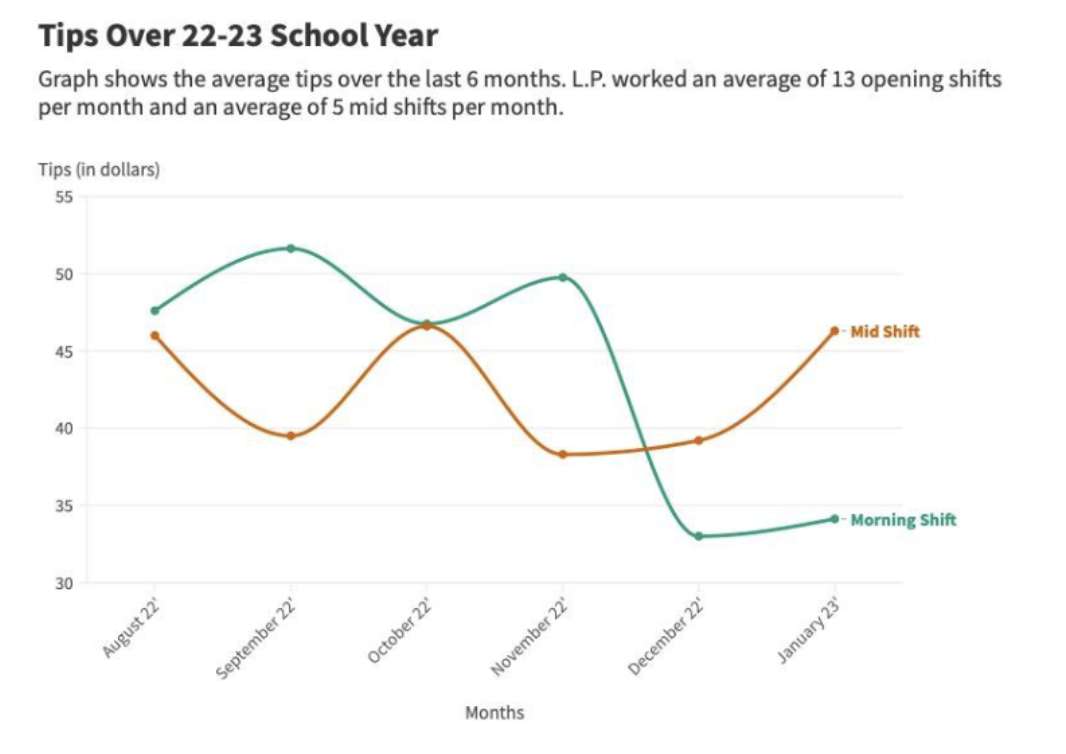
L.P. said these rising prices are also difficult for workers, because they’re the ones typically having to tell customers, who are often certain of the exact prices of their drinks, that there’s been a recent price increase. Older customers, they said, are especially prone to anger at this news.
Although there’s little the workers themselves can do about the prices on the menu, L.P. said they’ve found one workaround.
“We typically move around it and leave out certain charges as a form of resistance, and also just solidarity with the people who pay,” they said.
Regardless, Haggin said he has taken this opportunity to reflect on his broader spending habits. For example, instead of buying from coffee shops, he settles for the free black coffee in Forest Dining Hall. L.P. has adjusted their own spending habits out of necessity as well: instead of ordering a cold brew with cream or sugar, they said, they’ll use the milk and sugar they have in their apartment.
“I kind of get it, but at the same time, it definitely sucks for somebody who goes there regularly,” Haggin said. “Because I want to go there — I really liked the place and the people there are nice, but I just can’t justify a $7 purchase for a coffee I can chug in 10 minutes.”
L.P. said they and other employees at Soma have had conversations with management regarding pay raises at least since they began working there a year-and-a-half ago. Currently, baristas can receive a raise by advancing into a certain position — like an opener or trainer — or by being there for at least a year. Both of these net the employee a 25-cent pay increase, L.P. said.
However, the conversations with management haven’t been fruitful. To keep with chains like Starbucks — which enacted a $15 minimum wage in summer 2022 — L.P. said they believe a
$13 an hour wage, at minimum, would be fair for the employees who are currently struggling. A
business can’t raise prices and keep wages stagnant, they said, without hurting its workers. But, to keep pace with chains like Starbucks — which enacted a $15 minimum wage in summer 2022 — L.P. said they believe a $13 an hour wage, at minimum, would be fair for the employees who are currently struggling. A business can’t raise prices and keep wages stagnant, they said, without hurting its workers.
“I feel like if employees were being compensated for the raising of any prices, then it might be acceptable,” they said. “But, if everywhere is raising prices and only some are raising wages, I don’t think it’s possible.”